Annual lectures and special lectures
Our Annual Lectures and Special Lectures feature esteemed speakers who offer expert insights into the critical challenges and transformations affecting Europe today. Each year, we invite leading academics, policymakers, and thought leaders to share perspectives on impactful topics in European studies. These lectures provide an opportunity to engage with significant voices in the field, expanding your knowledge of Europe’s political, social, and economic dynamics. Check out our upcoming lectures and be part of these inspiring, knowledge-sharing events.
Annual Lecture 2025
On 10 July 2025, the MJMCE organised a public roundtable discussion during the official visit of the EU.The discussed was themed ‘ New European Security Landscape.
The Roundtable featured an illustrious panel of high-level diplomats and academics that engaged with a full Samuel Alexander Lecture Hall on questions of European Security.
Panellists included EU Ambassador to the UK Pedra Serrano, Ambassador of Slovakia to the UK Peter Susko, Maltese High Commissioner to the UK Stephen Montefort, High Commissioner of Cyprus to the UK Kyriacόs Kouros, University of Manchester Global Politics Professor Toni Haastrup and, as Chair, MJMCE Director Silke Trommer.
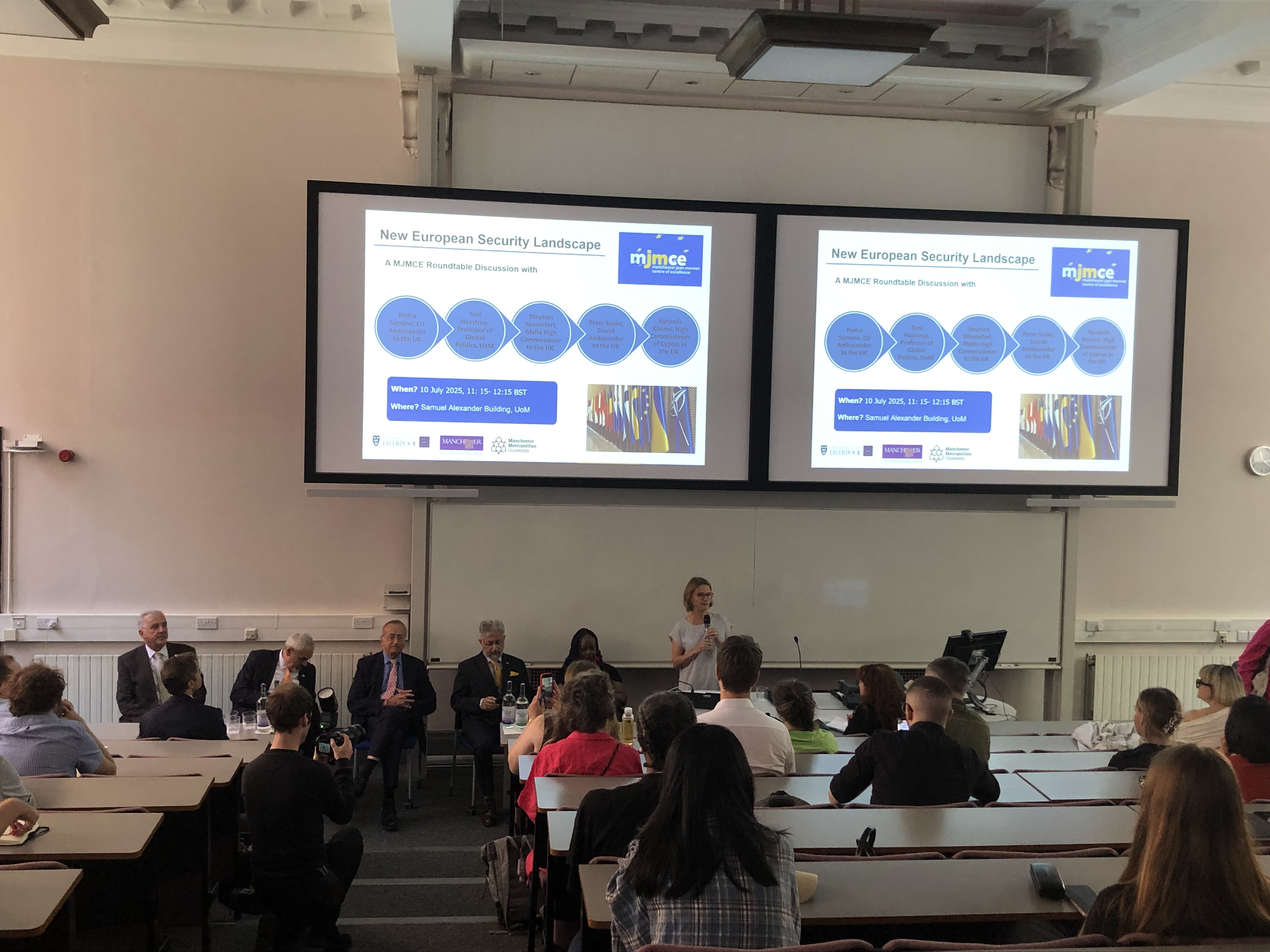
After introductory remarks on the future of EU-UK security cooperation, the prospects for de- escalating current security tensions, andpossibilities for promoting human security approaches in times of heightened military investment, the Chair opened thefloor to a 150 strong audience made up of students, staff and external guests from local, national and international politics.
The audience presented a barrage of questions and panellists regretted that their tight schedule did not allow them to extend the lively conversation beyond the allotted time. Feedback from panellists and audience members alike was highly positive and underscored the fact that the event will remain a highlight among the MJCME’s public outreach activities for years to come.
The EU Ambassador to the UK wrote a letter to show his appreciation, in which he mentioned the MJMCE lecture and thanked the MJMCE specifically.
Special Information Event - Italian Citizenship Law
On 18 July 2025 , the MJME collaborated with the National Association of Partisans in Italy (ANPI) and several UK and Italian based institutions and volunteer associations, an information event that discussed the implications of legislative changes to the new Italian citizenship law.
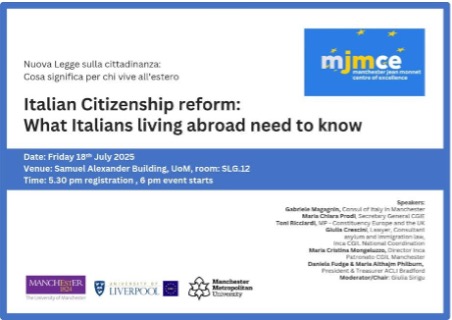
The event included a panel discussion featuring Italian institutional representatives, lawmakers involved in the drafting of the reform, support organisations working directly with applicants and members of the General Council of Italians Abroad, the advisory body to the Italian Government and Parliament on issues affecting Italians living outside Italy.
Annual Lecture 2023
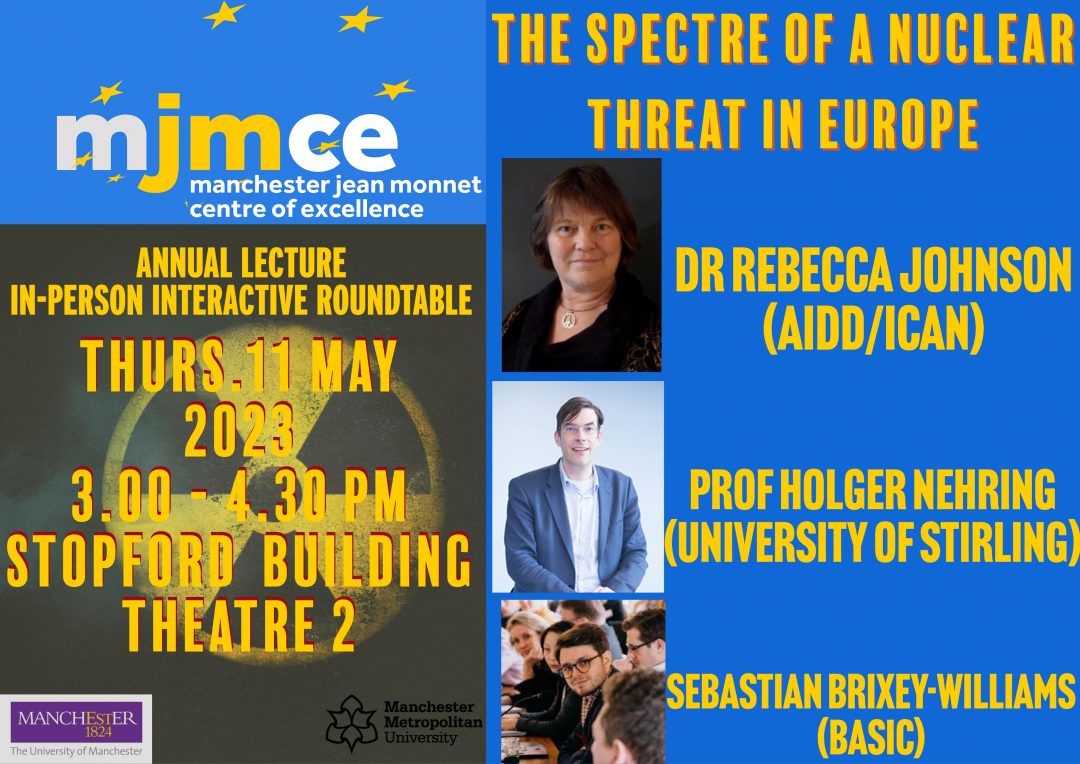
JMCE Annual Lecture 2023
“The Spectre of Nuclear Threat in Europe”
Responding to heightened concerns about the destructive power of nuclear weapons in the context of the War in Ukraine and its underlying geopolitical shifts, this interactive Roundtable brings together Dr Rebecca Johnson (AIDD/ICAN), Professor Holger Nehring (University of Stirling), and Sebastian Brixey-Williams (BASIC).
The Roundtable seeks to help us understand the consequences of the War in Ukraine for Europe’s security architecture, the international legal architecture for disarmament, and shed light on the tools available to regulate and prevent the use of nuclear weapons. It brings together views from academic, policy and activist circles and applies a format of short opening statements followed by discussions among roundtable participants responding to questions from the audience.
SPEAKER BIOS.
1. REBECCA JOHNSON PH.D. (AIDD/ICAN)
Dr Rebecca Johnson is executive director of the Acronym Institute for Disarmament Diplomacy and founding president of the International Campaign to Abolish Nuclear Weapons (ICAN, 2017 Nobel Peace Laureate) in Geneva. Since Acronym’s journal “Disarmament Diplomacy” closed in 2009, Dr Johnson’s publications have included “Unfinished Business”, based on her PhD from LSE on multilateral diplomacy and the CTBT, and numerous academic analyses on nonproliferation, disarmament, and humanitarian strategies to ban nuclear weapons, including the Oxford Handbook of Modern Diplomacy and over 50 articles on openDemocracy. More detail on her writings and activism over four decades of feminist peace activism are provided below.
Rebecca’s work for the Acronym Institute prioritises nuclear disarmament and security, in which she has particular expertise relating to nuclear technologies, treaties such as the CTBT and the Non-Proliferation Treaty (NPT), and verification. But she combines this with voluntary organising for justice and peace in every area of her life.
In addition to lectures and educational work with Acronym, she serves on the International Panel on Fissile Materials (IPFM) and International Steering Group (ISG) of the International Campaign to Abolish Nuclear Weapons (ICAN), following several years as ICAN Co-Chair and first President of ICAN Europe-Middle-East-Africa (EMEA), established in Geneva in 2011, with the aim of creating conditions for a global nuclear prohibition treaty to be negotiated and implemented.
On behalf of Acronym, Rebecca collaborates with the Campaign for Nuclear Disarmament (CND), Medact and Article 36 in managing ICAN-UK, most recently launching a new “Nukes of Hazard” campaign to raise awareness of the safety and security risks of Britain’s nuclear convoys, which carry Trident warheads between the Atomic Weapons Establishments (AWE) at Aldermaston and Burghfield (west of London) to the deployment bases in Scotland at Faslane and Coulport (north of Glasgow). She has contributed to various studies undertaken by parliamentary committees in the UK and European Parliament on defence and foreign affairs, and represented the Green Party of England and Wales (GPEW) in security and defence debates before the 2015 General Election.
Rebecca’s many analyses, reports, articles and books since the 1980s have focused mainly on diplomatic efforts through the UN and various treaties to promote disarmament and peace. Her extensive analyses on the NPT, Conference on Disarmament, UN First Committee and British nuclear policy from 1994 are available via the Acronym Institute website, either archives or current, including reporting from Nuclear Proliferation News and Disarmament Diplomacy, and various articles published by the Bulletin of the Atomic Scientists, Arms Control Association or academic journals. While providing contemporaneous analyses from negotiations, Rebecca’s writings have also highlighted the strategies and roles undertaken by civil society to build peace and tackle violence in our lives and nations. Her book on civil society and government strategies to achieve the CTBT, titled Unfinished Business, was published in May 2009 by the UN Institute for Disarmament Research. Her most recent books are Trident and International Law, co-edited with Angie Zelter (Luath Press, 2011), and Decline or Transform: Nuclear disarmament and security beyond the NPT review process (with John Borrie and Tim Caughley, Acronym Institute, London 2012). She has been a featured writer for openDemocracy since 2010, and commentator on nuclear issues for various media, including CNN and the BBC.
Prior to developing the Acronym Institute, Rebecca coordinated Greenpeace International’s campaigns on nuclear testing and plutonium from 1988-92, as well as doing 6 month stints as an emergency planning officer for a London Nuclear Free Zone Council, and another six months as a nuclear test ban campaigner for Medact. During the 1980s she was best known for living at the Greenham Common Women’s Peace Camp during its most crucial campaigning period, from 1982-87, where she was an organiser and participant in many of Greenham’s most influential actions, including “Embrace the Base” (December 1982), “Dancing on the Silos” (January 1983), the “Greenham Women versus Cruise” legal action in the United States (November 1983), “Occupying the Air Traffic Control Tower” (December 1983).
In addition, she engaged in protest actions against cluster munitions at RAF/USAF Welford (1986), and many other awareness-raising activities with Greenham, Cruisewatch, Women Working for a Nuclear Free and Independent Pacific (WWNFIP), and Nukewatch. She co-founded the Aldermaston Women’s Peace Camp(aign) in 1985 to protest against UK weapons research, and more recently co-organised Action AWE (Atomic Weapons Eradication) and Faslane 365 to expose the risks to national and international peace, safety and security posed by the UK’s continuing production and deployment of Trident nuclear weapons. Since 2010, Rebecca was made a CND Vice President and Fellow of the Royal Society of Arts (FRSA), in recognition of her years of voluntary and professional work for disarmament, peace and women’s rights and justice.
In parallel with her professional work and grassroots activism on disarmament issues, Rebecca has campaigned for many decades to promote nonviolent approaches for women, peace and security, as illustrated in the first two essays published in her name: “Alice Through the Fence”, in Nuclear Weapons, the Peace Movement and the Law, published by Macmillan Press in 1986; and in a 1988 book of essays edited by Amanda Sebestyen titled “68, 78, 88: from Women’s Liberation to Feminism”. Addressing feminist perspectives on peace and nonviolence in theory and practice, these early reflections illustrated the core concerns that have dominated Rebecca’s life and work for the past four decades, including through the Acronym Institute.
Though best known internationally for her Acronym-related work on disarmament negotiations and treaties, Rebecca’s long record of feminist peace-building was highlighted in the British Library’s recent commemoration of UK-based contributors to women’s liberation and rights “Sisterhood and After”. Parallelling her campaigns for peace and disarmament, she stood in the 1983 General Election as a peace candidate for “Women for Life on Earth”, and has continued to promote equality, opportunities and rights for women through campaigns opposing gender-based violence, such as Million Women Rise, and the priority she gives to creating safer, harassment-free spaces and working conditions, as well as involving and mentoring young women to gain confidence and skills to contribute more fully in peace-building and security efforts around the world.
After volunteering with Women’s Aid to Former Yugoslavia, driving aid trucks to support women, peace activists and refugees during the wars of 1991-99, Rebecca co-founded the “Women Against Warcrimes” campaign in the UK, which soon after changed its name to “Women in Black”, holding weekly peace vigils in London, as part of the growing international Women in Black movement, which continues today to campaign for justice, against violence and war around the world. Most recently, Rebecca served as one of eight jurors for the 2015 World Court of Women held in Bangalore, India, organised by Vimochana Women’s Rights Forum in conjunction with the International Gathering of Women in Black. Rebecca is also a member of the Women’s International League for Peace and Freedom (WILPF) and the women’s advisory group for the International Action Network on Small Arms (IANSA).
Previous professional and voluntary roles include coordinating the influential grassroots Faslane365 campaign in Scotland during 2006-07 and serving on the Scottish Government’s Working Group on Nuclear Weapons. Prior to this she was Senior Advisor for the International Weapons of Mass Destruction Commission (Blix Commission, 2004-2006) and Vice Chair of the Board of the Bulletin of the Atomic Scientists (2001-7). She periodically advises governments, international institutions and civil society organisations, including the United Nations, the European Parliament, the Nobel Women’s Initiative, the Interaction Council, as well as advising several NGOs ranging from the Center for Policy Studies (PIR Moscow) to Mayors for Peace.
As well as her PhD in multilateralism from LSE, Rebecca holds a B.Sc. from Bristol University and an MA from London University’s School of Oriental and African Studies (SOAS).
more details: http://acronym.org.uk/about/who-we-are/our-team/
2. PROF. HOLGER NEHRINGAM (UNIVERSITY OF STIRLING)
Professor Holger Nehring (DPhil, Oxford) is a contemporary historian of Europe (including Britain) He researches on two themes: the transnational history of social movements (especially anti-nuclear weapons movements) and the history of the Cold War (in particular the history of military infrastructure). Before joining Stirling’s Division of History, Heritage and Politics in September 2013, he was based in various positions at the University of Sheffield.
Holger is currently Co-I on a project with Dr Sam Alberti at National Museums on ‘Materialising the Cold War’, generously funded by the AHRC. He also holds a British Academy Innovation Fellowship (together with Wilton Park, the Foreign Commonwealth and Development Office’s executive agency) to work on paradiplomacy and regional development in the UK context (https://pare.stir.ac.uk/).
Holger has held a number of visiting research fellowships at universities in Europe and north America: at the Forum for Contemporary History, Oslo and the Norwegian Nobel Institute (2007 and 2008); at the Mershon Center for International Security Studies, Columbus, OH, USA (2009); at the Hamburg Institute for Social Research (2009); at the Ecole des Hautes Etudes en Sciences Sociales (EHESS), Paris (as professeur invité in 2010); at the History Department at the University of Michigan, Ann Arbor, MI, USA (2012); and at CISAC-TEC at Stanford (2019).
more details: https://www.stir.ac.uk/people/256854
3. SEBASTIAN BRIXEY-WILLIAMS (BASIC)
Sebastian Brixey-Williams is the Executive Director of BASIC, where he works with governments and experts globally to implement practical strategies to safeguard humanity and Earth’s ecosystem from nuclear risks and interconnected security threats. He is also an Honorary Research Associate at the School of Government, University of Birmingham.
Sebastian’s research focuses on legal, normative, and confidence-building measures to reduce risks of nuclear weapons use. He convenes backchannel risk reduction dialogues in both the Euro-Atlantic and the Asia-Pacific, with a focus on South Asia. In 2016, he co-founded the Programme on Nuclear Responsibilities with the Institute for Conflict, Cooperation and Security at the University of Birmingham, to stimulate a more robust international conversation about states’ responsibilities in relation to nuclear weapons.
Sebastian holds an MA with distinction in International Studies and Diplomacy from the School of Oriental and African Studies (SOAS), University of London, where he received the Postgraduate School’s Prize, and his BA in English and French Literature with distinction from the University of York. He is currently a supervisor to three PhDs.
more details: https://basicint.org/our-staff/sebastian-brixey-williams/
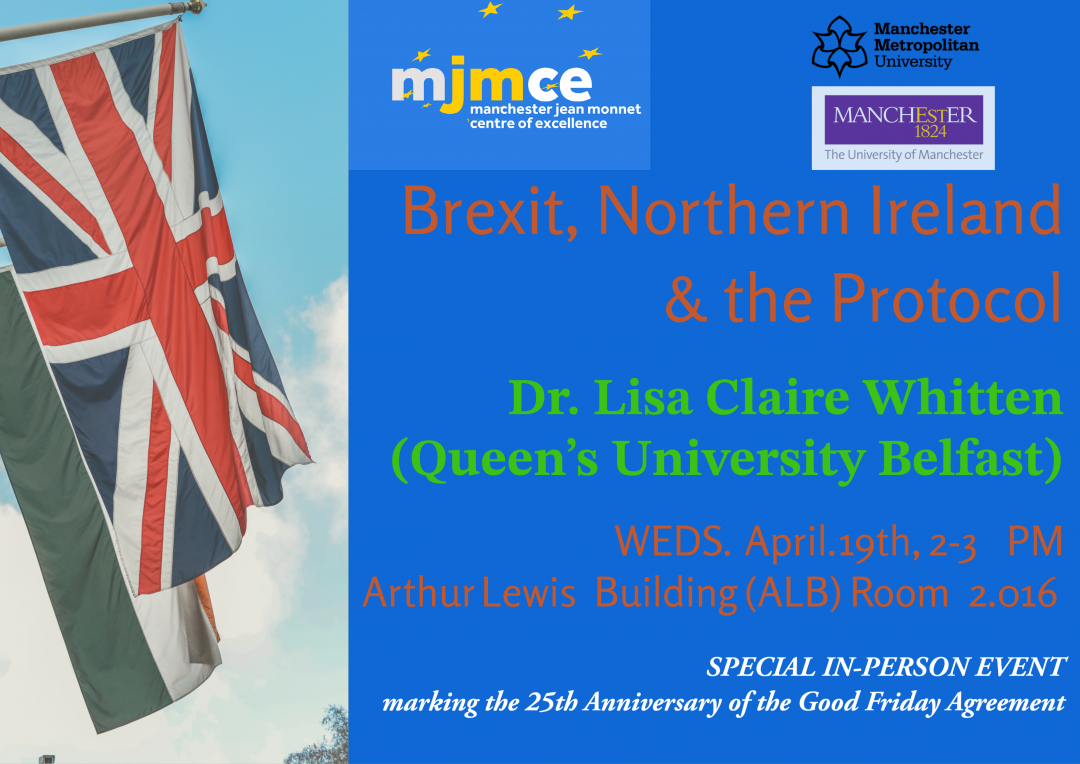
Special Event marking the anniversary of the Good Friday Agreement
Annual Lecture 2021 2022
Contact Us
Find Us
Manchester Jean Monnet Centre of Excellence
The University of Manchester,
Oxford Road, Manchester
M13 9PL, UK

